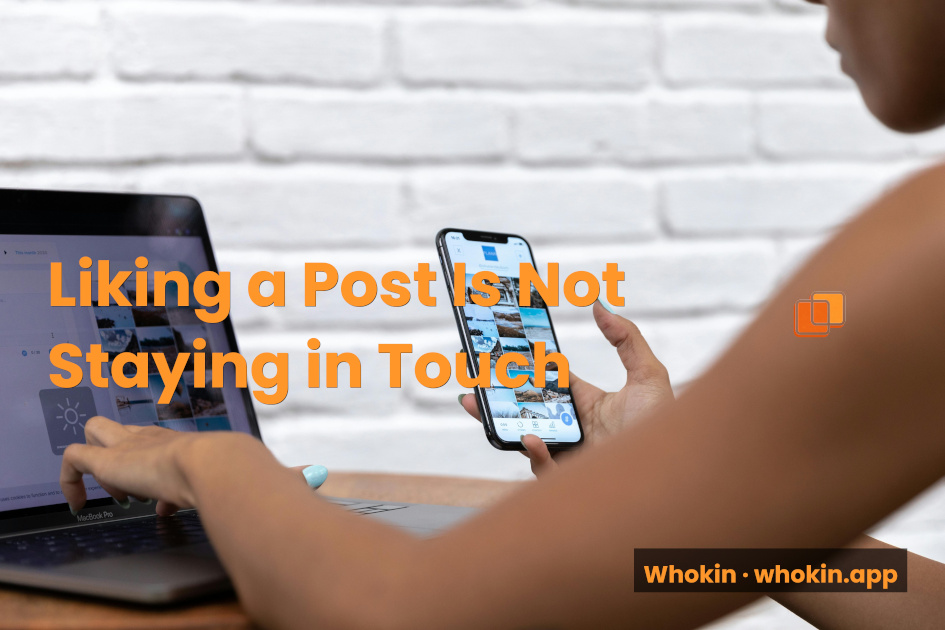
You follow your old university friend on Instagram. You see her posts. You like them occasionally. You know she got a promotion, you saw the holiday photos, you watched the stories about her cat. And yet — if she called you tomorrow with a problem, you would realise with a start that you have no idea what is actually going on in her life. The visibility is perfect. The connection is zero.
The like that isn't love
A like is a unit of acknowledgment, not a unit of care. It costs nothing, requires nothing, and communicates almost nothing. The person who liked your post is not the same as the person who picked up the phone because they thought about you.
This distinction matters because both activities produce a feeling — however brief — of having "been in touch." The like satisfies some of the same impulse as a real interaction, without actually sustaining the relationship. It is social contact as processed sugar: it registers briefly and leaves nothing behind.
You can follow someone for five years and know less about their actual life than you'd learn in a ten-minute phone call.
The parasocial drift
Social platforms are optimised for parasocial relationships — the sense of knowing someone without any reciprocal connection. Celebrities, influencers, public figures all generate this sensation at scale. The problem is that we apply the same passive-consumption mode to our actual friends, and the relationship slowly becomes parasocial too: you watch their life rather than participating in it.
The intervention: one directed message
Research on social wellbeing finds that sending a specific, directed message to a specific person — one that references something personal, something you both share — produces significantly more wellbeing benefit than an equivalent amount of passive scrolling. The content matters less than the directness.
Whokin's nudge system points you at the right person at the right time and gives you the context to send a message that isn't generic. That is the mechanism: directed, specific, human contact. Not a feed.